
How Does Aluminum Material Grade Impact Mold Cost
How Does Aluminum Material Grade Impact Mold Cost?
A Practical Breakdown for Product Teams Choosing Between Speed, Durability, and Budget
When you’re racing to validate a new product—maybe a smart appliance housing, a limited-run dustbin, or a prototype for investor testing—you’ve likely been told:
“Go with an aluminum mold—it’s fast and affordable.”
But not all aluminum molds are created equal. In fact, the specific aluminum alloy used can dramatically affect your mold’s performance, lifespan, surface finish, and yes—total cost.
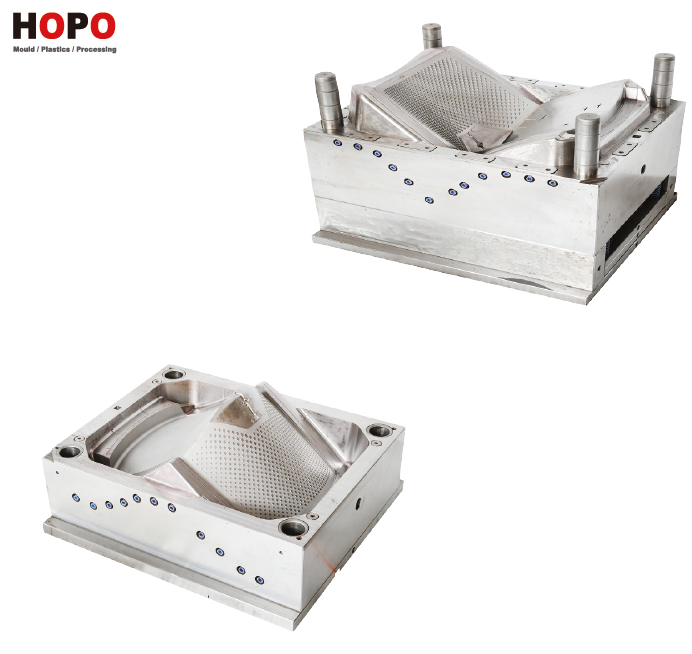
At HOPO Mould, we’ve built hundreds of aluminum injection molds since 2012 for clients in home appliances, daily commodities, and industrial sectors. We’ve seen projects thrive with the right alloy—and others face premature wear, warpage, or rework because cost-cutting led to the wrong material choice.
So let’s go beyond the generic advice. Below, we unpack how aluminum grades truly impact your mold investment, and how to choose wisely.
Why Does the Aluminum Grade Even Matter?
Because aluminum isn’t just “aluminum.”
Just as you wouldn’t build a race car with bicycle-grade steel, you shouldn’t assume all aluminum alloys behave the same under the heat, pressure, and friction of injection molding.
Different grades offer vastly different:
- Hardness and wear resistance
- Machinability and surface finish potential
- Thermal conductivity and dimensional stability
- Weldability and repairability
Choosing the wrong grade might save $500 upfront—but cost you thousands in scrapped parts, mold repairs, or delayed launches.
What Are the Most Common Aluminum Grades Used for Injection Molds?
Not every aluminum alloy is suitable for molding. The industry relies on a few proven performers:
7075-T6 Aluminum
- Hardness: ~150 HB (very high for aluminum)
- Strength: Excellent tensile and fatigue resistance
- Best for: High-precision molds, parts with tight tolerances, moderate-volume production (up to 10,000 shots)
- Drawback: More expensive; harder to machine than softer alloys
6061-T6 Aluminum
- Hardness: ~95 HB
- Strength: Good general-purpose performance
- Best for: Prototypes, low-volume runs (<5,000 shots), non-abrasive materials like PP or ABS
- Drawback: Softer—wears faster with glass-filled resins or aggressive ejection
QC-10 (Aluminum Alloy from Quebec)
- Hardness: ~110 HB
- Strength: Balanced machinability and durability
- Best for: Rapid tooling where surface finish and moderate life (5,000–8,000 shots) are needed
- Note: Popular in North America; less common in Asia but available on request
At HOPO Mould, we typically recommend 7075-T6 for clients who need reliable performance beyond simple prototyping—especially for home appliance or automotive pre-series parts.
Does a Higher-Grade Aluminum Always Mean a Higher Mold Cost?
Generally, yes—but not always in a bad way.
Here’s how cost breaks down by grade (for a typical single-cavity mold at HOPO):
| Aluminum Grade | Relative Cost (vs. 6061) | Best Use Case |
|---|---|---|
| 6061-T6 | Baseline (1.0x) | Quick prototypes, concept validation |
| QC-10 | +15–25% | Better surface finish, moderate life |
| 7075-T6 | +30–50% | Functional prototypes, pilot production, tighter tolerances |
While 7075-T6 costs more upfront, it often reduces your cost-per-part by lasting longer and producing more consistent shots. If you need 8,000 good parts—not just 500—this premium pays for itself.
Think of it like tires on a delivery van: cheap tires save money today but wear out fast. Premium tires cost more but keep you on the road longer.
Can You Use Cheap or Recycled Aluminum to Save Money?
Technically, yes—but strongly discouraged.
Low-grade or recycled aluminum often has:
- Inconsistent hardness (leading to uneven wear)
- Internal porosity (causing leaks or surface defects)
- Poor thermal stability (increasing warpage risk)
We’ve seen molds made from uncertified aluminum develop pitting at the gate after just 1,000 shots—or warp during machining due to internal stress.
At HOPO, we only use certified, aerospace-grade aluminum with full material traceability. It’s non-negotiable for quality and repeatability.
How Does Aluminum Grade Affect Part Quality and Surface Finish?
Significantly.
- 7075-T6 machines to a smoother finish and holds fine details (like textures or logos) better than softer alloys.
- 6061-T6 can develop micro-scratches during ejection or cleaning, especially on glossy surfaces.
- Softer aluminum also expands more under heat, which can subtly shift part dimensions over a production run.
If your part requires VDI 3400 texture, SPI-A polish, or tight cosmetic standards, 7075-T6 is almost always the better choice—even for short runs.
Does the Aluminum Grade Limit What Plastics You Can Mold?
Yes—especially with filled or abrasive resins.
- Unfilled materials (PP, ABS, HDPE, PC): Safe in any aluminum grade.
- 30% glass-filled nylon, PBT, or mineral-filled PP: Highly abrasive. These will rapidly erode 6061, but 7075 can handle 2,000–5,000 shots with acceptable wear.
- High-temp resins (like PEEK): Not suitable for aluminum at all—stick to steel.
At HOPO, we always ask: “What material will you run?” before finalizing the mold material. It’s part of our Design for Manufacturing (DFM) review—ensuring your mold and resin are compatible from day one.
So… Which Aluminum Grade Should You Choose?
Ask yourself:
- Is this a one-time prototype or a pilot run? → 6061 may suffice.
- Do I need 5,000+ consistent parts? → Lean toward 7075-T6.
- Am I using glass-filled or abrasive plastic? → Avoid 6061.
- Is surface finish critical? → 7075 machines cleaner and polishes better.
- Is my timeline tight but budget flexible? → Pay a little more for reliability.
Remember: the cheapest mold isn’t the one with the lowest quote—it’s the one that delivers the right parts, on time, without rework.
Partner with HOPO for Smart, Grade-Appropriate Aluminum Molds
At TAIZHOU HOPO MOULD & PLASTIC TECHNOLOGY CO., LTD, we don’t treat aluminum molds as “disposable tools.” We engineer them with the same care as our steel counterparts—because your product’s success depends on it.
Located in Huangyan, Taizhou—the heart of China’s mould industry—we combine:
- Certified aluminum grades (6061, 7075, QC-10 on request)
- Mold flow simulation for thermal and filling analysis
- 3–4 week lead times for most aluminum molds
- Full DFM support to match material, mold grade, and production goals
With Taizhou Airport just 40 minutes away and the railway station 15 minutes from our factory, we make global collaboration fast and reliable.
Have a part ready for prototyping or pilot production? Send us your 3D file—and we’ll recommend the optimal aluminum grade, provide a transparent quote, and explain exactly why it’s the right fit for your project.
Because at HOPO, we believe the best mold isn’t defined by its material alone—but by how well it serves your vision.
Related Articles
 The Top Injection Molding Industry Leader 2026-02-24 0
 2026 Injection Molding Industry Leader 2026-02-24 0
 USA Top Custom Moulding Experts 2026-02-11 0
 2026 Architectural and Decorative Moulding Leaders in USA 2026-02-11 0
 2026 Top Industrial Plastic Injection Moulding Titans 2026-02-02 0
- 2026 Top Moulding Company 2026-02-02 0
- What Is an Aluminum Injection Mold and Why Is It Used 2026-01-19 0
 The Cost of an Aluminum Injection Mold 2026-01-19 0
 What Affects the Cost of an Aluminum Injection Mold 2026-01-19 0
 What Is the Strength of the 7 Most Common Injection Molding Plastics 2026-01-12 0
 How Thick Can You Injection Mold Plastic 2026-01-12 0
 What Are the 7 Steps of PLC 2025-12-16 0
 What Is PLC in Injection Molding 2025-12-16 0
- What Is the Minimum Wall Thickness of the 7 Main Types of Plastic 2025-12-11 0
 Industry Standards or Guidelines for Wall Thickness by Application 2025-12-11 0
 Why Does Plastic Shrink More in Thick Sections in Injection Molding 2025-12-02 0
 The Strongest Plastic for Injection Molding 2025-12-02 0
- Why is Machine Assistance Essential in High-Demand Mould Shops 2025-11-20 0
 Common Defects and Limitations Must Mold Finishers Anticipate with CP 2025-11-20 0
 Why Ultrasonic Polishing is Essential for Precision Mould Features 2025-11-12 0
