
How Do Material Dictate Temperature in Moulding
How Do Material Properties Dictate Your Temperature Strategy in Moulding?
In injection moulding, blow moulding, or compression forming, temperature isn’t just a setting—it’s a language. And the material you’re processing is the speaker. Whether you’re shaping a medical-grade polycarbonate implant or a polypropylene automotive bumper, the thermal behavior of your polymer doesn’t merely influence your temperature strategy—it defines it.
But why do two seemingly similar plastics demand wildly different barrel, mould, and cooling profiles? And how can engineers turn material science into process mastery? Let’s explore how the intrinsic properties of polymers silently command every degree in your thermal playbook.
What Does “Temperature Strategy” Really Mean in Moulding?
It’s easy to think of temperature control as simply “heating the barrel and cooling the mould.” In reality, a robust temperature strategy is a multi-zone thermal orchestration that includes:
- Barrel temperature profile (feed, compression, metering zones)
- Nozzle and hot runner temperatures
- Mould surface temperature (often controlled via water, oil, or electromagnetic induction)
- Cooling time and ejection temperature
- Resin drying and pre-heating conditions (for hygroscopic materials)
Each of these must be tuned not to a generic “best practice,” but to the specific thermal, rheological, and morphological response of the material itself. Get it wrong, and you risk warpage, sink marks, poor surface finish—or worse, molecular degradation.
Why Can’t We Use the Same Temperature Profile for All Plastics?
Because polymers aren’t just “meltable solids”—they’re complex viscoelastic systems with unique thermal fingerprints. Three material properties dominate your temperature decisions:
1. Glass Transition Temperature (Tg)
The temperature at which an amorphous polymer transitions from a rigid, glassy state to a soft, rubbery one.
- Below Tg: Material is brittle, dimensionally stable.
- Above Tg: Chains gain mobility—critical for flow and stress relaxation.
For amorphous resins like ABS, PC, or PS, mould temperature must be above Tg to allow polymer chains to relax during packing, reducing internal stresses and improving surface replication. Run too cold, and you get frozen-in orientation, leading to warpage or cracking.
2. Melting Temperature (Tm)
The crystalline melting point—where ordered lamellae break down into a disordered melt.
- Applies to semi-crystalline polymers: PP, PE, PA (nylon), POM (acetal), PEEK.
These materials require barrel temperatures well above Tm (often +30–80°C) to fully melt crystalline domains. But here’s the catch: cooling rate through Tm dictates final crystallinity.
- Fast cooling → low crystallinity → higher impact strength but lower chemical resistance.
- Slow cooling → high crystallinity → better dimensional stability but increased shrinkage.
Thus, mould temperature becomes a crystallinity control knob—not just a cooling parameter.
3. Thermal Degradation Temperature (Td)
The threshold beyond which polymer chains scission, cross-link, or release volatiles.
- Exceeding Td causes yellowing, odor, loss of mechanical properties, or gas traps.
Engineering resins like PEEK (Td ≈ 550°C) tolerate high processing temps, but PVC (Td ≈ 180–200°C) degrades rapidly if overheated. Your barrel profile must stay safely between Tm (or Tg) and Td—a narrow window for sensitive materials.
How Does Melt Viscosity Shape Your Heating and Flow Strategy?
Viscosity isn’t just about “thickness”—it’s temperature- and shear-dependent. The relationship is captured by the Arrhenius equation for amorphous polymers or the Williams-Landel-Ferry (WLF) model near Tg:
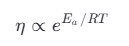
Where ( Ea ) = activation energy, ( R ) = gas constant, ( T ) = absolute temperature.
This means:
- A 10°C increase can reduce viscosity by 20–30%—dramatically easing flow into thin walls or complex geometries.
- But overheating risks degradation, especially in high-viscosity, high-Ea materials like PSU or LCP.
Moreover, shear-thinning behavior (viscosity drops under high shear) allows lower melt temps in high-injection-speed processes—but only if the material can handle the shear stress without chain breakage.
Thus, your temperature profile must balance flowability against thermal stability, often requiring gradient heating: cooler in the feed zone (to prevent bridging), hotter in metering (to ensure homogeneity).
Why Does Mould Temperature Affect More Than Just Cycle Time?
Because for many polymers, mould temperature governs microstructure—and microstructure dictates performance.
-
Amorphous polymers (e.g., PC, PMMA):
High mould temps (>Tg + 10–20°C) allow chains to relax, yielding:
✅ Low residual stress
✅ High gloss and surface fidelity
✅ Better optical clarity
❌ Longer cycle times -
Semi-crystalline polymers (e.g., PA6, POM):
Mould temp directly controls crystallization kinetics:- At 40°C: PA6 crystallizes slowly → 20–25% crystallinity
- At 120°C: Rapid nucleation → 35–40% crystallinity
Higher crystallinity means greater stiffness, chemical resistance, and shrinkage—so two identical parts moulded at different temps may fail dimensional or functional specs.
In high-precision applications (e.g., optical lenses or fluidic manifolds), mould temperature uniformity must be held to ±1°C—not for speed, but for molecular consistency.
What Happens If You Ignore Material-Specific Thermal Limits?
The consequences range from cosmetic flaws to catastrophic failure:
| Material | Risk of Incorrect Temp Strategy |
|---|---|
| PVC | Degradation → HCl gas emission, black specks, corrosion |
| PET | Incomplete drying + high heat → hydrolysis → molecular weight drop → brittle parts |
| PEEK | Mould too cold → poor crystallization → reduced chemical/thermal resistance |
| TPU | Overheating → cross-linking → gel particles, nozzle drool |
| Nylon (PA6/66) | Low mould temp → post-mould moisture absorption → dimensional drift |
These aren’t theoretical—they’re daily production realities. A 15°C deviation can turn a Class A automotive surface into a reject pile.
How Do Additives and Fillers Complicate the Thermal Picture?
Most engineering resins aren’t pure polymers—they’re composites:
- Glass fiber (20–50%): Increases thermal conductivity → faster cooling, but raises melt viscosity → requires higher barrel temps.
- Flame retardants: Often degrade near 300°C—forcing lower processing windows even in high-Tg resins like PC.
- Lubricants or nucleating agents: Alter crystallization onset—shifting optimal mould temps.
- Colorants (e.g., carbon black): Absorb IR radiation → uneven heating in barrel or hot runners.
Thus, material datasheets must be read holistically—not just for base resin properties, but for compound-specific thermal guidelines.
Can You “Fix” a Poor Temperature Strategy with Process Tweaks?
Sometimes—but only within narrow bounds.
- Increasing injection speed can compensate for slightly high viscosity—but may cause jetting or shear burn.
- Extending packing time helps with sink marks from fast cooling—but can’t recover lost crystallinity.
- Lowering melt temp reduces degradation—but may cause short shots or weld lines.
In truth, temperature strategy is foundational. Process parameters are fine-tuners; material-driven thermal design is the architecture.
What’s the Smart Way to Develop a Material-Driven Temperature Profile?
Follow this engineering workflow:
- Consult the resin supplier’s processing guide—they’ve tested degradation, flow, and crystallization.
- Map critical temperatures: Tg, Tm, Td, drying requirements.
- Set barrel zones: Start 10–20°C above Tm (semi-crystalline) or Tg (amorphous), tapering down toward feed zone.
- Determine mould temp: Based on desired crystallinity (semi-crystalline) or stress relief (amorphous).
- Validate with DSC (Differential Scanning Calorimetry): Confirm actual crystallinity and thermal transitions in your process.
- Iterate with DOE (Design of Experiments): Test ±10°C around baseline to optimize surface, dimensions, and cycle time.
Remember: the material is your co-engineer. Listen to its thermal language.
So—Why Does This All Matter Beyond the Mould Floor?
Because temperature strategy isn’t just about making parts—it’s about ensuring function, safety, and sustainability.
- In medical devices, residual stress from low mould temps can cause sterilization-induced cracking.
- In EV battery housings, inconsistent crystallinity in PPA leads to seal failure under thermal cycling.
- In consumer electronics, poor PC surface replication ruins aesthetic and brand perception.
Moreover, optimized thermal profiles reduce energy use by 15–25%—aligning with global decarbonization goals. Every degree saved is a step toward leaner, greener manufacturing.
Temperature Is the Material’s Voice—Are You Listening?
In moulding, we don’t impose temperature. We respond to it—guided by the silent, molecular logic of the polymer itself. The most successful engineers don’t ask, “What temperature should I use?” They ask, “What is this material trying to tell me about how it wants to flow, solidify, and perform?”
Master that dialogue, and you don’t just make parts—you engineer reliability, beauty, and purpose, one precise degree at a time.
Related Articles
 The Top Injection Molding Industry Leader 2026-02-24 0
 2026 Injection Molding Industry Leader 2026-02-24 0
 USA Top Custom Moulding Experts 2026-02-11 0
 2026 Architectural and Decorative Moulding Leaders in USA 2026-02-11 0
 2026 Top Industrial Plastic Injection Moulding Titans 2026-02-02 0
- 2026 Top Moulding Company 2026-02-02 0
- What Is an Aluminum Injection Mold and Why Is It Used 2026-01-19 0
 How Does Aluminum Material Grade Impact Mold Cost 2026-01-19 0
 The Cost of an Aluminum Injection Mold 2026-01-19 0
 What Affects the Cost of an Aluminum Injection Mold 2026-01-19 0
 What Is the Strength of the 7 Most Common Injection Molding Plastics 2026-01-12 0
 How Thick Can You Injection Mold Plastic 2026-01-12 0
 What Are the 7 Steps of PLC 2025-12-16 0
 What Is PLC in Injection Molding 2025-12-16 0
- What Is the Minimum Wall Thickness of the 7 Main Types of Plastic 2025-12-11 0
 Industry Standards or Guidelines for Wall Thickness by Application 2025-12-11 0
 Why Does Plastic Shrink More in Thick Sections in Injection Molding 2025-12-02 0
 The Strongest Plastic for Injection Molding 2025-12-02 0
- Why is Machine Assistance Essential in High-Demand Mould Shops 2025-11-20 0
 Common Defects and Limitations Must Mold Finishers Anticipate with CP 2025-11-20 0
