How to Avoid Sink Marks in Injection Molding
author: CHEN
2025-04-21
The Impact of Sink Marks on Injection Molding Quality
Sink marks are a common yet troublesome defect in injection molding. These unsightly depressions or indentations on the surface of molded parts can not only detract from the product’s aesthetic appeal but also affect its structural integrity and marketability. For injection molding manufacturers, it’s critical to address sink marks proactively to ensure the highest possible quality and cost-effective production. Next HOPO Mould will take you to find out the causes of sink marks, provide best practices to prevent them, and explore advanced techniques that can help you maintain consistent, high-quality output.
What Are Sink Marks in Injection Molding?
Sink marks are small depressions or indentations that form on the surface of a molded part, particularly in areas where the material is thicker. They occur when the plastic material inside the mold cools unevenly, causing the surface to shrink more than the internal material. While these marks are often cosmetic, they can sometimes affect the strength or functionality of the part. Sink marks typically appear in the following cases:
- Thick-walled sections of the part
- Uneven cooling rates within the mold cavity
- Improper packing pressure
- Uneven cooling rates within the mold cavity
- Improper packing pressure
These marks are often found in parts with varying wall thicknesses and are particularly problematic in high-quality products, where appearance and precision are critical.
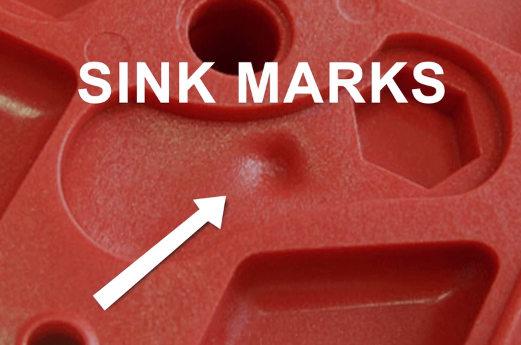
What Will Causes Sink Marks in Injection Molding?
Understanding the root causes of sink marks is crucial for manufacturers looking to eliminate them from their processes. Here are the primary reasons why sink marks occur:
1. Uneven Cooling and Shrinkage
The most common cause of sink marks is uneven cooling of the injected material. Thicker sections of the molded part take longer to cool than thinner ones, which leads to differential shrinkage. The result is often sink marks in areas where the material hasn’t had time to shrink uniformly.
2. Insufficient Packing Pressure
Packing pressure plays a vital role in filling the mold completely and ensuring that the part solidifies correctly. When the packing pressure is too low, the molten material may not fill the mold cavity entirely, leading to voids inside the part that cause shrinkage and sink marks.
3. Material Choice and Flow Properties
The viscosity of the material used in injection molding affects how well it flows into the mold. High-viscosity materials tend to fill the mold more slowly, creating uneven solidification and increasing the likelihood of sink marks. Selecting materials with better flow characteristics can help minimize this problem.
4. Improper Injection Speed and Pressure
If the injection speed is too fast or too slow, or if the injection pressure is inadequate, it can lead to an incomplete filling of the mold. This results in areas of the part that are not fully packed, creating sink marks due to improper material distribution.
5. Mold Design Issues
Finally, issues with the mold design, such as poor venting or incorrect gate placement, can cause air pockets or uneven cooling, both of which can contribute to sink marks. Parts with thick sections and sharp corners are particularly susceptible.

How to Avoid Sink Marks in Injection Molding
Now that we understand the causes, let's focus on the best practices manufacturers can implement to prevent sink marks in their injection molding processes:
1. Increasing packing pressure is one of the most effective ways to reduce sink marks. By maintaining a higher packing pressure, you can ensure that the material fills the mold cavity completely, minimizing voids and reducing the chances of sink marks.
2. Cooling rate control is essential for preventing sink marks. Thicker sections of a part require longer cooling times, which can lead to uneven shrinkage. By using multi-zone cooling and adjusting the cooling rates across the mold, you can ensure more uniform cooling and shrinkage, preventing sink marks.
3. Choosing the right material is one of the most critical factors in preventing sink marks. Opt for materials that shrink evenly and have a high flowability. Materials with low viscosity can help fill the mold cavity more evenly and reduce the formation of sink marks. Consider using reinforced plastics that have better dimensional stability.
4. To minimize sink marks, consider optimizing the mold design. This includes:
- Avoiding thick-walled areas and using more consistent wall thickness throughout the part.
- Designing parts with gentle curves and eliminating sharp corners that can lead to uneven cooling.
- Properly placing gates and improving venting to ensure the mold cavity is filled evenly.
- Avoiding thick-walled areas and using more consistent wall thickness throughout the part.
- Designing parts with gentle curves and eliminating sharp corners that can lead to uneven cooling.
- Properly placing gates and improving venting to ensure the mold cavity is filled evenly.
5. Increasing the injection speed can help ensure the mold cavity is filled more efficiently, reducing the risk of sink marks. However, this must be done carefully, as injecting too quickly can cause other issues, such as short shots or flash.
How to Prevent Sink Mark?
In addition to standard practices, there are more advanced techniques available to injection molding manufacturers looking to eliminate sink marks:
1. Gas-Assisted Injection Molding
Gas-assisted injection molding uses gas (usually nitrogen) to inject into the mold during the filling phase. This technique helps reduce the material density in thick-walled sections and ensures uniform filling, thus preventing sink marks.
2. Hot Runner Systems
A hot runner system helps maintain the melt temperature throughout the injection molding process. By keeping the material at a consistent temperature, hot runners reduce the likelihood of temperature variation that could cause sink marks.
3. Rheological Modifications
Using additives or reinforcements in the material can improve its flowability and reduce the shrinkage rate. Reinforced materials, such as those with glass fiber, have better dimensional stability, reducing sink mark formation.
4. Injection Molding Simulation Software
Modern injection molding simulation software can predict the potential for sink marks before a part is even molded. By analyzing the mold design and material properties, manufacturers can optimize the process to avoid defects, reducing trial and error.
Sink Marks Troubleshootin
Let’s take a look at a case study where an injection molding manufacturer successfully eliminated sink marks:
A manufacturer of automotive parts noticed sink marks appearing on the surface of a key component used in their vehicles. These sink marks were particularly evident in the thick-walled areas of the part, affecting the part’s appearance and functionality.
After analyzing the issue, the company took the following steps:
1. Increased packing pressure to ensure complete mold filling.
2. Implemented multi-zone cooling to control cooling rates more effectively.
3. Optimized mold design by reducing wall thickness variations and improving gate placement.
4. Switched to a material with better flow properties and lower shrinkage.
1. Increased packing pressure to ensure complete mold filling.
2. Implemented multi-zone cooling to control cooling rates more effectively.
3. Optimized mold design by reducing wall thickness variations and improving gate placement.
4. Switched to a material with better flow properties and lower shrinkage.
After implementing these changes, the manufacturer successfully eliminated sink marks, improving both the appearance and structural integrity of the part. Production efficiency increased, and the parts met the required quality standards.
Sink-Free Injection Molding
Sink marks are a common challenge in injection molding, but with the right techniques and adjustments, manufacturers can significantly reduce or eliminate them. By optimizing packing pressure, controlling cooling rates, selecting the right materials, and refining mold designs, manufacturers can ensure high-quality, sink-free molded parts. Additionally, advanced methods such as gas-assisted injection molding and hot runner systems offer powerful tools for further optimization.
With these strategies in place, manufacturers can achieve consistent, high-quality results, ensuring their products meet both aesthetic and functional requirements. If you're experiencing sink marks in your injection molding process, it’s time to make the necessary adjustments to improve your production line’s efficiency and the quality of your products.
Ready to Optimize Your Injection Molding Process?
Contact us today for a consultation on how we can help you eliminate sink marks and improve the quality of your injection molded products. Our experts are here to guide you through every step of the process.
Contact us today for a consultation on how we can help you eliminate sink marks and improve the quality of your injection molded products. Our experts are here to guide you through every step of the process.
Related Articles
 The Top Injection Molding Industry Leader 2026-02-24 0
 2026 Injection Molding Industry Leader 2026-02-24 0
 USA Top Custom Moulding Experts 2026-02-11 0
 2026 Architectural and Decorative Moulding Leaders in USA 2026-02-11 0
 2026 Top Industrial Plastic Injection Moulding Titans 2026-02-02 0
- 2026 Top Moulding Company 2026-02-02 0
- What Is an Aluminum Injection Mold and Why Is It Used 2026-01-19 0
 How Does Aluminum Material Grade Impact Mold Cost 2026-01-19 0
 The Cost of an Aluminum Injection Mold 2026-01-19 0
 What Affects the Cost of an Aluminum Injection Mold 2026-01-19 0
 What Is the Strength of the 7 Most Common Injection Molding Plastics 2026-01-12 0
 How Thick Can You Injection Mold Plastic 2026-01-12 0
 What Are the 7 Steps of PLC 2025-12-16 0
 What Is PLC in Injection Molding 2025-12-16 0
- What Is the Minimum Wall Thickness of the 7 Main Types of Plastic 2025-12-11 0
 Industry Standards or Guidelines for Wall Thickness by Application 2025-12-11 0
 Why Does Plastic Shrink More in Thick Sections in Injection Molding 2025-12-02 0
 The Strongest Plastic for Injection Molding 2025-12-02 0
- Why is Machine Assistance Essential in High-Demand Mould Shops 2025-11-20 0
 Common Defects and Limitations Must Mold Finishers Anticipate with CP 2025-11-20 0
