
How to Calculate Cavity Pressure in Injection Molding

How to Calculate Cavity Pressure in Injection Molding
In injection molding, understanding and controlling cavity pressure is crucial for producing high-quality parts consistently. Cavity pressure affects material flow, part density, dimensional accuracy, and even cycle time. For engineers looking to optimize their molding processes, knowing how to calculate cavity pressure—and why it matters—can make all the difference.
Let's see the basics of cavity pressure, explains how to calculate it, and offers practical insights on how to use this information to improve your manufacturing process.
What Is Cavity Pressure and Why Does It Matter?
Cavity pressure is the pressure exerted by the molten plastic inside the mold cavity during injection and packing phases. It directly influences how well the mold fills and how the material sets, impacting:
- Part strength and surface finish
- Avoidance of defects like sink marks, voids, or warpage
- Consistency across production cycles
By monitoring and calculating cavity pressure, engineers can fine-tune injection parameters, reduce waste, and improve overall efficiency.
How to Calculate Cavity Pressure?
Calculating cavity pressure involves understanding the forces acting within the mold and the relationship between injection pressure, mold dimensions, and material behavior. Here’s a simplified overview:
Step 1: Understand the Variables
- Injection Pressure (P_inj): The pressure set on the molding machine’s screw or plunger during injection, usually measured in megapascals (MPa) or psi.
- Projected Area (A): The cross-sectional area of the molded part facing the injection direction, typically in square millimeters (mm²) or square inches (in²).
- Clamp Force (F_clamp): The force required to keep the mold closed against the injection pressure to avoid flash.
Step 2: Basic Cavity Pressure Formula
The cavity pressure (P_cav) can be estimated by considering the injection pressure and losses due to flow resistance, but a commonly used approximation is:

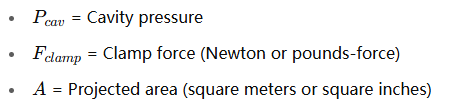
This formula tells you the maximum pressure the cavity can withstand without mold separation but doesn't account for pressure drops inside the melt flow.
Step 3: Using Pressure Sensors for Real-Time Data
For more accurate calculation and monitoring, many manufacturers use cavity pressure sensors embedded inside the mold. These sensors provide real-time pressure curves throughout injection and packing, enabling:
- Detection of peak pressure
- Identification of pressure drop points
- Correlation of pressure data with part quality
Practical Example of Cavity Pressure Calculation
Suppose you have:
- Clamp force: 1000 kN (kilonewtons)
- Projected area of part: 0.5 m²
Then, the approximate cavity pressure is:

This is the maximum pressure the cavity can withstand before mold separation. The actual cavity pressure during injection will be somewhat lower due to flow losses.
Why Monitoring Cavity Pressure Improves Your Process
Monitoring cavity pressure is like having a window into the heart of your injection molding process. Instead of relying on guesswork or visual inspection alone, real-time pressure data gives you precise insights into what’s happening inside the mold during every cycle. Here’s why that matters:
1. Ensures Optimal Mold Filling
By tracking cavity pressure, you can confirm that the molten plastic is filling the mold completely and evenly. If the pressure drops unexpectedly, it could indicate short shots or air traps forming — issues that cause defects or weak spots in your parts. Early detection means you can adjust parameters like injection speed or pressure before defects multiply.
2. Helps Prevent Common Defects
Many molding problems—such as sink marks, voids, flash, or warpage—are directly linked to inconsistent or incorrect cavity pressure. Monitoring pressure lets you identify and correct the root causes quickly, rather than reacting to poor-quality parts after production.
3. Optimizes Cycle Time
Pressure data reveals exactly when the cavity is filled and packed sufficiently, allowing you to fine-tune packing time and injection speed. This optimization can shorten cycle times without sacrificing quality, boosting overall productivity and reducing energy costs.
4. Improves Process Stability and Repeatability
Stable cavity pressure profiles across multiple cycles mean consistent part quality. Monitoring pressure helps you spot variations caused by wear, material changes, or machine issues early on—keeping your process reliable and predictable.
5. Supports Data-Driven Decision Making
With accurate cavity pressure data, process engineers can base adjustments on real measurements rather than assumptions. This leads to smarter process control, reduced trial-and-error, and faster troubleshooting.
6. Facilitates Advanced Process Control and Automation
Modern injection molding setups increasingly rely on automated systems. Integrating cavity pressure monitoring enables closed-loop control where machines adjust parameters dynamically to maintain optimal pressure, ensuring peak performance and minimal waste.
In short, monitoring cavity pressure transforms injection molding from a reactive process into a proactive, optimized system—saving you time, materials, and costs while consistently delivering high-quality parts.
Choosing the Right Sensors and Monitoring Systems
Accurate and reliable cavity pressure measurement depends largely on the right choice of sensors and monitoring equipment. With numerous options available, selecting the best fit for your specific mold and production requirements is key to unlocking valuable process insights and improving product quality.
Key Sensor Types for Cavity Pressure
-
Piezoelectric Pressure Sensors These sensors generate an electrical charge proportional to the applied pressure. They are prized for their:
-
High sensitivity and fast response times — ideal for capturing rapid pressure changes during injection and packing.
- Wide pressure range capability, suitable for various molding conditions.
-
Durability in harsh environments, making them a go-to choice for many manufacturers.
-
Strain Gauge Sensors Strain gauges measure deformation in the mold surface caused by cavity pressure. Advantages include:
-
Robustness and long-term stability, allowing continuous monitoring over extended production runs.
-
Good accuracy for applications where slightly slower response time is acceptable.
-
Wireless Pressure Sensors Wireless systems are gaining popularity for:
-
Simplified installation, eliminating complex wiring and reducing mold modification time.
- Flexibility, allowing sensors to be easily relocated between molds or machines.
- Some models offer real-time data transmission to control systems or mobile devices for immediate feedback.
What to Consider When Selecting Pressure Monitoring Equipment
- Mold size and complexity: Larger or multi-cavity molds may require multiple sensors placed strategically to capture representative pressure data.
- Production environment: Consider temperature ranges, exposure to moisture, and mechanical stresses sensors will face.
- Data acquisition and analysis needs: Ensure compatibility with your existing injection molding machines and quality control software. Some systems provide advanced analytics and alarm functions to flag abnormal pressure profiles.
- Budget and maintenance: Balance upfront sensor costs with ease of maintenance and potential downtime impact.
Integrating Sensors into Your Process
For maximum benefit, pressure sensors should be integrated with your injection molding machine’s control system or connected to a dedicated data acquisition platform. This integration allows for:
- Real-time monitoring and adjustments during production
- Data logging for quality assurance and traceability
- Trend analysis to predict maintenance needs or identify process drift
Trusted Suppliers and Solutions
Leading suppliers offer turnkey cavity pressure monitoring kits tailored to injection molding, including sensor hardware, mounting accessories, and software interfaces. When evaluating options, look for:
- Proven industry experience and support
- Calibration and certification services
- Training and technical assistance
Knowing how to calculate cavity pressure and monitoring it during production empowers engineers to maintain tight process control, improve quality, and reduce costs. Whether you’re optimizing a new mold or troubleshooting production issues, cavity pressure data is a powerful tool in your injection molding toolbox.
Ready to enhance your molding process with advanced cavity pressure monitoring? Contact us today to learn about our latest sensor technology and process optimization services.
Related Articles
 The Top Injection Molding Industry Leader 2026-02-24 0
 2026 Injection Molding Industry Leader 2026-02-24 0
 USA Top Custom Moulding Experts 2026-02-11 0
 2026 Architectural and Decorative Moulding Leaders in USA 2026-02-11 0
 2026 Top Industrial Plastic Injection Moulding Titans 2026-02-02 0
- 2026 Top Moulding Company 2026-02-02 0
- What Is an Aluminum Injection Mold and Why Is It Used 2026-01-19 0
 How Does Aluminum Material Grade Impact Mold Cost 2026-01-19 0
 The Cost of an Aluminum Injection Mold 2026-01-19 0
 What Affects the Cost of an Aluminum Injection Mold 2026-01-19 0
 What Is the Strength of the 7 Most Common Injection Molding Plastics 2026-01-12 0
 How Thick Can You Injection Mold Plastic 2026-01-12 0
 What Are the 7 Steps of PLC 2025-12-16 0
 What Is PLC in Injection Molding 2025-12-16 0
- What Is the Minimum Wall Thickness of the 7 Main Types of Plastic 2025-12-11 0
 Industry Standards or Guidelines for Wall Thickness by Application 2025-12-11 0
 Why Does Plastic Shrink More in Thick Sections in Injection Molding 2025-12-02 0
 The Strongest Plastic for Injection Molding 2025-12-02 0
- Why is Machine Assistance Essential in High-Demand Mould Shops 2025-11-20 0
 Common Defects and Limitations Must Mold Finishers Anticipate with CP 2025-11-20 0
